
Signs it's time to replace, not repair
- Leaks at many seams that come back after being resealed
- Sagging in several places or gutters that won't hold pitch
- Bent, dented or corroded metal, rust spots or holes
- Overflow in ordinary storms even when clean, which suggests gutters or downspouts that are too small
- Widespread fascia rot that means the gutters must come down anyway
- Mismatched patchwork from years of section-by-section fixes
If it's just one or two problem spots, start with gutter repair. It usually costs far less.
Seamless vs. sectional gutters
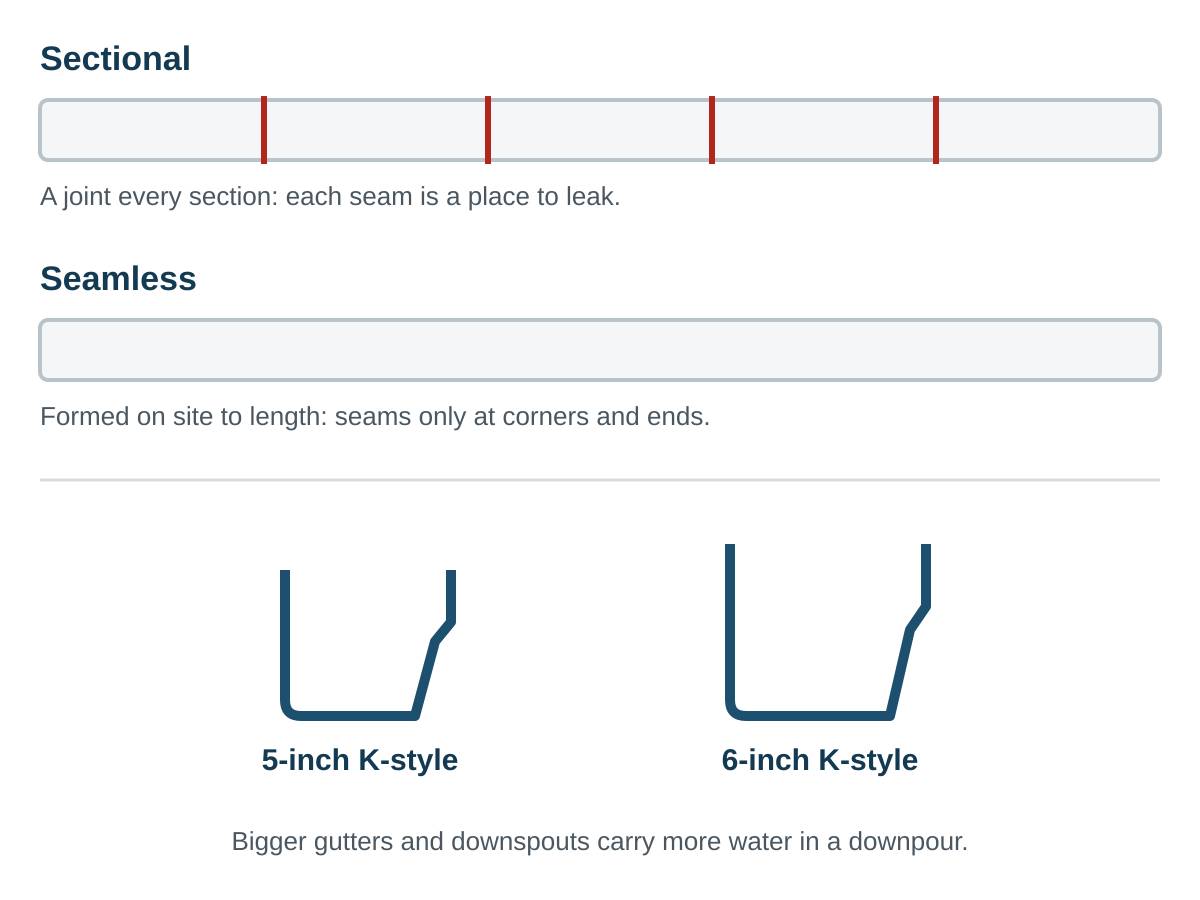
Sectional gutters come in pre-cut lengths joined together, so a long run can have several joints, and every joint depends on sealant. Seamless gutters are rolled out on site from a coil to the exact length of each run. The only seams are at corners, end caps and outlets.
- Fewer leaks: fewer joints to fail
- Cleaner look: continuous lines along the roof edge
- Custom fit: each run is made to measure
Aluminum is the most common material for seamless gutters. Steel and copper are also available and cost more.
5-inch vs. 6-inch gutters
Gutter size is about how much water the system can move in a heavy downpour. Summer thunderstorms around Marietta can drop a lot of rain in a short time, and that's when undersized gutters overflow.
| 5-inch K-style | 6-inch K-style | |
|---|---|---|
| Common on | Many single-family homes with moderate roof areas | Large or steep roofs, long runs, valleys, heavy tree cover |
| Capacity | Standard | Noticeably more water per minute |
| Typical downspouts | 2×3-inch or 3×4-inch | 3×4-inch |
| Debris | Clogs more easily | Wider opening, clogs less easily |
| Cost | Lower | Somewhat higher per foot |
General guidance only. The right size depends on your roof area, pitch and how many downspouts it has.
Don't forget the downspouts
Bigger gutters don't help if the water can't leave. Larger downspouts, or an extra downspout on a long run, often do as much to stop overflow as the gutter size itself. See downspout cleaning and repair.
The typical replacement process
- Measure each run, count corners and downspouts, and look at roof areas and valleys to size the system.
- Remove old gutters, hangers and downspouts.
- Inspect and repair the fascia now that it's exposed. See fascia and soffit repair.
- Form seamless runs on site and hang them with hidden hangers at the correct pitch.
- Install downspouts, elbows, straps and extensions, and connect to any underground drains.
- Seal corners and end caps, water-test, and clean up.
What affects the cost
- Linear feet of gutter and the number of corners
- Size and material: 6-inch costs more than 5-inch; steel and copper cost more than aluminum
- Number and size of downspouts
- Stories and roof pitch
- Fascia repair discovered when the old gutters come off
- Guards, if added (see gutter guards and whether they're worth it)
Replacement is usually priced by the foot, so footage, size and material drive most of the cost. See the cost guide, or call (678) 721‑8964 for a free estimate on your home.
Questions to ask a pro
- Do my gutters really need replacing, or would repairs do?
- What size gutters and downspouts do you recommend for my roof, and why?
- What gauge or thickness of aluminum do you use?
- What hangers, and at what spacing?
- How will you handle rotted fascia if you find it, and how is that priced?
- What does your workmanship warranty cover, and for how long? (Get it in writing.)
- Do you haul away the old gutters?
When to call a professional
Gutter replacement means working along the whole roof edge at height, and correct sizing and pitch take experience. Tell us about your home and we'll connect you with an experienced, qualified local professional for an estimate.