
The cleaning-to-guards upsell
Read enough local reviews of gutter companies and a pattern shows up: a homeowner calls about a routine cleaning, and the conversation turns to a guard system that costs many times more. Sometimes that's genuinely good advice. Often it's just a bigger sale.
Here's our position. Marietta Gutter Cleaning & Repair is a referral service. If you ask for a cleaning, we'll connect you with a pro for a cleaning. If you want to explore guards, we'll connect you with a pro for that. Either way, this guide should help you decide with a clear head.
What gutter guards can and can't do
They can: keep most leaves out of the gutter, reduce how often it needs a full cleaning, lower the risk of downspout clogs, and cut down on ladder trips.
They can't: stop everything, fix gutters that sag or leak, make an undersized gutter carry more water, or make gutters maintenance-free. No guard is maintenance-free. Pollen, shingle grit, seed pods and pine needles still find their way onto or into every type. Some guards also make it harder to clean the gutter when something does get in.
Gutter guard types compared
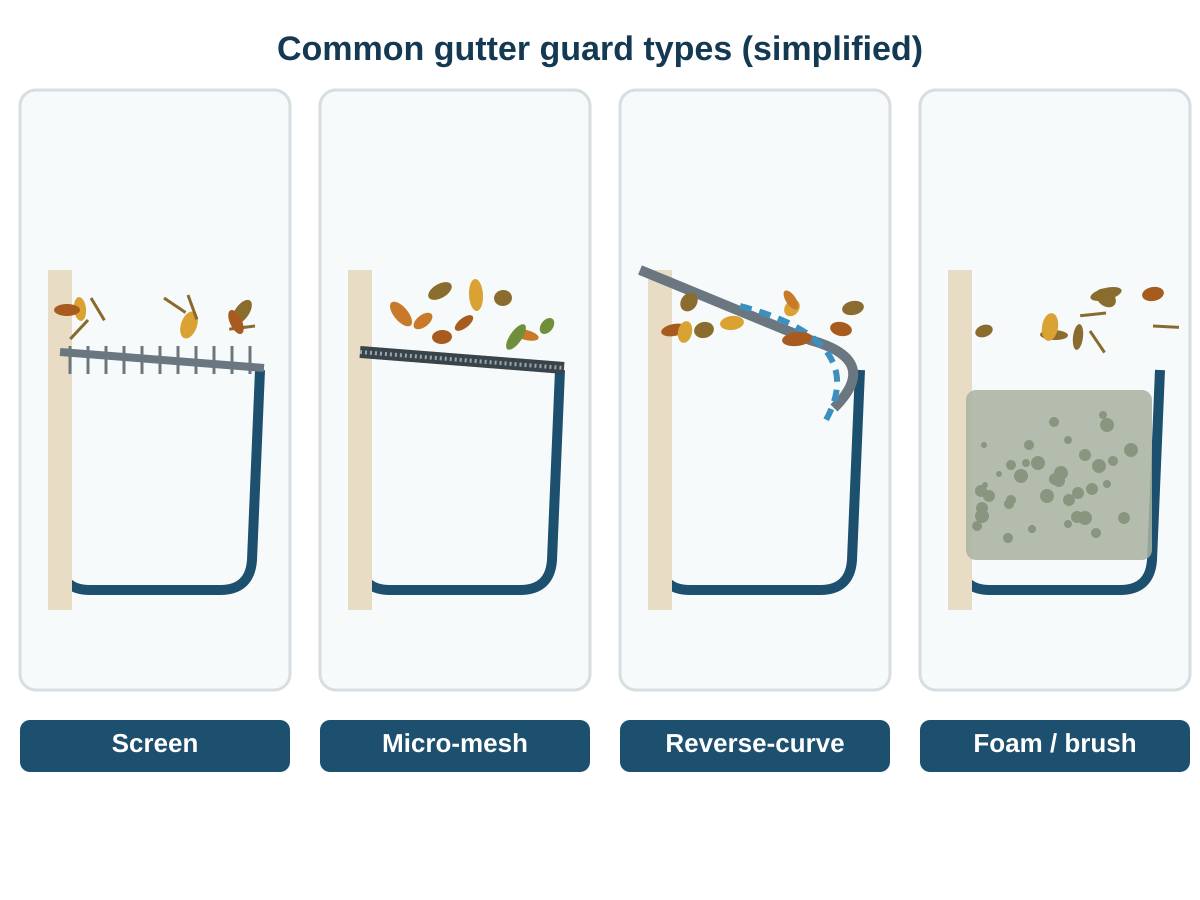
1. Screens (perforated metal or wire)
A grid with fairly large openings that sits over the gutter. Pros: inexpensive, easy to install, stop large leaves. Cons: pine needles, seeds and small debris slip through or lodge in the holes; flimsy plastic screens sag. Best for homes with mostly broadleaf trees and a modest budget.
2. Micro-mesh
A very fine stainless steel mesh on a rigid frame. Pros: stops almost all leaves and pine needles; water passes through readily when the mesh is clean. Cons: costs more, especially professionally installed; fine pollen and grit can film over the mesh and need rinsing; needles can mat on top. Usually the strongest option under pines.
3. Reverse-curve (surface tension or "hood") guards
A solid cover. Water follows the curved lip into a slot while leaves slide off the front. Pros: sheds big leaves well; durable. Cons: expensive; very heavy rain can shoot past the lip; needles and small debris can follow water into the slot, and the gutter behind the hood is harder to reach and clean. Their appearance changes the look of the roofline.
4. Foam and brush inserts
Filler that sits inside the gutter. Pros: cheapest; DIY friendly on single-story homes. Cons: needles, seeds and sprouts get stuck in them; foam can hold moisture and break down; inserts must be pulled out to clean. Generally a poor match for pine-heavy lots.
| Type | Leaves | Pine needles | Relative cost | Upkeep |
|---|---|---|---|---|
| Screen | Good | Poor–fair | Low | Moderate |
| Micro-mesh | Very good | Good | Medium–high | Low–moderate (rinse/brush) |
| Reverse-curve | Good | Fair | High | Moderate (slot and gutter behind) |
| Foam / brush | Fair | Poor | Low | High |
Performance varies by brand and installation. For installed options and prices, see our gutter guard service guide.
Pine needles vs. hardwood leaves: why Marietta is tricky

Many Marietta and Cobb County lots have a mix of pines and hardwoods such as oaks, red maples, sweetgums and tulip poplars. Loblolly pine is the most common tree in Georgia, and sweetgum, red maple and tulip poplar are among the most common hardwoods in the Piedmont. The two cause different problems:
- Hardwood leaves fall mostly over a few weeks in late fall. They're big and flat, so nearly every guard type sheds them. Without guards, one well-timed cleaning after the drop handles most of it.
- Pine needles fall on and off through the year as older needles age out, with heavier drops in late summer and fall. They're thin and stiff, so they slip through screens, spear into foam and brushes, and can follow water into hood slots. They also mat into a dense layer on top of guards.
- Spring debris like oak tassels, maple seeds, sweetgum balls and pine pollen coats guards and gutters alike.
Practical takeaway: if pines hang over your roof, a guard that can't handle needles isn't worth buying. Fine micro-mesh is usually the only type worth considering there, and it still needs occasional brushing.
Doing the math
Guards are an up-front cost meant to replace some future cleanings. A simple way to compare:
- Get a guard quote for your home (ask for the full installed price, including any repairs needed first).
- Estimate what you spend on cleanings each year now (the cost guide explains what drives cleaning prices).
- Subtract any cleaning or maintenance the guards will still need.
- Divide: guard price ÷ yearly savings = years to break even.
Example A (worth considering): two-story home under tall pines and oaks, four cleanings a year. Guards remove most of those visits. Break-even might be a handful of years, and you get fewer ladder trips.
Example B (probably not): single-story home with a couple of small trees, one cleaning a year. Guards would take many years to pay off, and you'd still rinse them occasionally.
These examples are illustrations, not quotes. Run the numbers with real prices for your home.
Money isn't the only factor. If the home is tall or the roof is steep, fewer ladder trips have real safety value. If you'd rather never think about gutters, that convenience has value too. Just make that choice knowingly.
A quick decision checklist
| Question | Leans "keep cleaning" | Leans "guards may pay off" |
|---|---|---|
| How many trees hang over the roof? | Few or none | Several tall trees directly over the roof |
| How many cleanings do you need a year to stay clear? | One or two | Three or more |
| What falls most? | Mostly broad leaves in fall | Pine needles year-round, or both |
| How tall is the home, how steep the roof? | Single story, low pitch | Two stories or steep |
| Condition of your gutters? | Sagging, leaking or undersized (fix first) | Solid, well pitched, well attached |
| How long will you stay? | Selling within a few years | Staying for many years |
Mostly in the left column? A regular cleaning schedule is probably your best value. See how often to clean gutters in Cobb County. Mostly in the right? Guards are worth pricing out.
Fix the gutters before you guard them
Guards installed on sagging, leaking or undersized gutters just hide the problem. Before any guard goes on, the gutters should be cleaned, correctly pitched, firmly attached and sealed. If they overflow in heavy rain even when clean, the fix may be bigger gutters or more downspouts, not guards. See gutter repair, downspout cleaning and repair, and seamless gutter replacement.
Questions to ask before you buy
- Which guard do you recommend for my trees, and why that type?
- What maintenance will these still need, and how often?
- How do they attach? Could they affect my roof warranty?
- Will you clean, repair and water-test my gutters first?
- What exactly does the warranty cover, for how long, and is it in writing?
- What's the price for a cleaning alone, so I can compare?
- Can I have a few days to decide? (The answer should be yes.)
Red flags
- "You'll never have to clean your gutters again."
- A price that's only good if you sign today
- No mention of fixing sagging or leaking gutters first
- A guard recommendation that ignores what trees you have
The bottom line
Gutter guards are a tool, not a cure. Under heavy trees, especially pines, on a tall or steep home, a good micro-mesh guard often earns its keep. On a single-story home with light tree cover, a cleaning or two a year is usually the smarter spend. Either way, you should get the job you asked for.
Want a pro's opinion on your home? Call (678) 721‑8964 or request a free estimate, and tell us whether you want a cleaning, a guard quote, or both. See also our gutter guard service page.